Login
Login

 1800 233 5333
Buying a home is a major financial decision, and knowing the price of the property is only one part of the
planning. You also need to understand how much you may have to repay every month, how much
interest you could pay over the loan tenure and how changing the loan amount or tenure can affect
your overall cost.
A home loan EMI calculator can help you get these numbers before you apply for a loan. By entering the
loan amount, interest rate and repayment tenure, you can estimate your monthly EMI and understand
the overall repayment amount.
Whether you are buying your first home, constructing a house or considering a home loan for another
property, calculating your EMI in advance can help you choose a repayment plan that fits your budget.
What Is a Home Loan EMI Calculator?
A home loan EMI calculator is an online financial tool that estimates the Equated Monthly Instalment
(EMI) you may need to pay towards a home loan.
The calculation is primarily based on three inputs:
• Loan amount – the amount you plan to borrow
• Interest rate – the annual rate applicable to the loan
• Loan tenure – the period over which you plan to repay the loan
The calculator uses these details to estimate your monthly EMI, total interest payable and total amount
payable over the selected tenure.
It is useful because you can change the inputs and immediately see how your repayment changes. This
allows you to compare different loan scenarios before making a borrowing decision.
Important: An EMI calculator provides an estimate. Your actual EMI may vary depending on the final loan amount, applicable interest rate, disbursement, repayment terms and other conditions of the lender.
Home Loan EMI Calculator at a Glance
Before using an EMI calculator, it helps to understand what it actually tells you.
What does a home loan EMI calculator calculate?
Depending on the calculator, you can typically see:
• Estimated monthly EMI
• Total interest payable
• Total amount payable
• Effect of changing the loan tenure
• Effect of changing the interest rate
• Effect of changing the loan amount
What information do you need?
You generally need three basic details:
• Loan amount: The amount you intend to borrow.
• Interest rate: The annual interest rate applicable to the loan. The rate used for an estimate should
reflect the rate you expect to be applicable, rather than simply choosing the lowest advertised
rate.
• Loan tenure: The number of years over which you plan to repay the loan.
Why use an EMI calculator before taking a home loan?
A calculator can help you:
• Set a realistic monthly repayment budget
• Compare different loan amounts
• Understand the cost of a longer or shorter tenure
• Estimate the total interest payable
• Plan your down payment and borrowing requirement
• Avoid choosing a loan amount based only on the property price
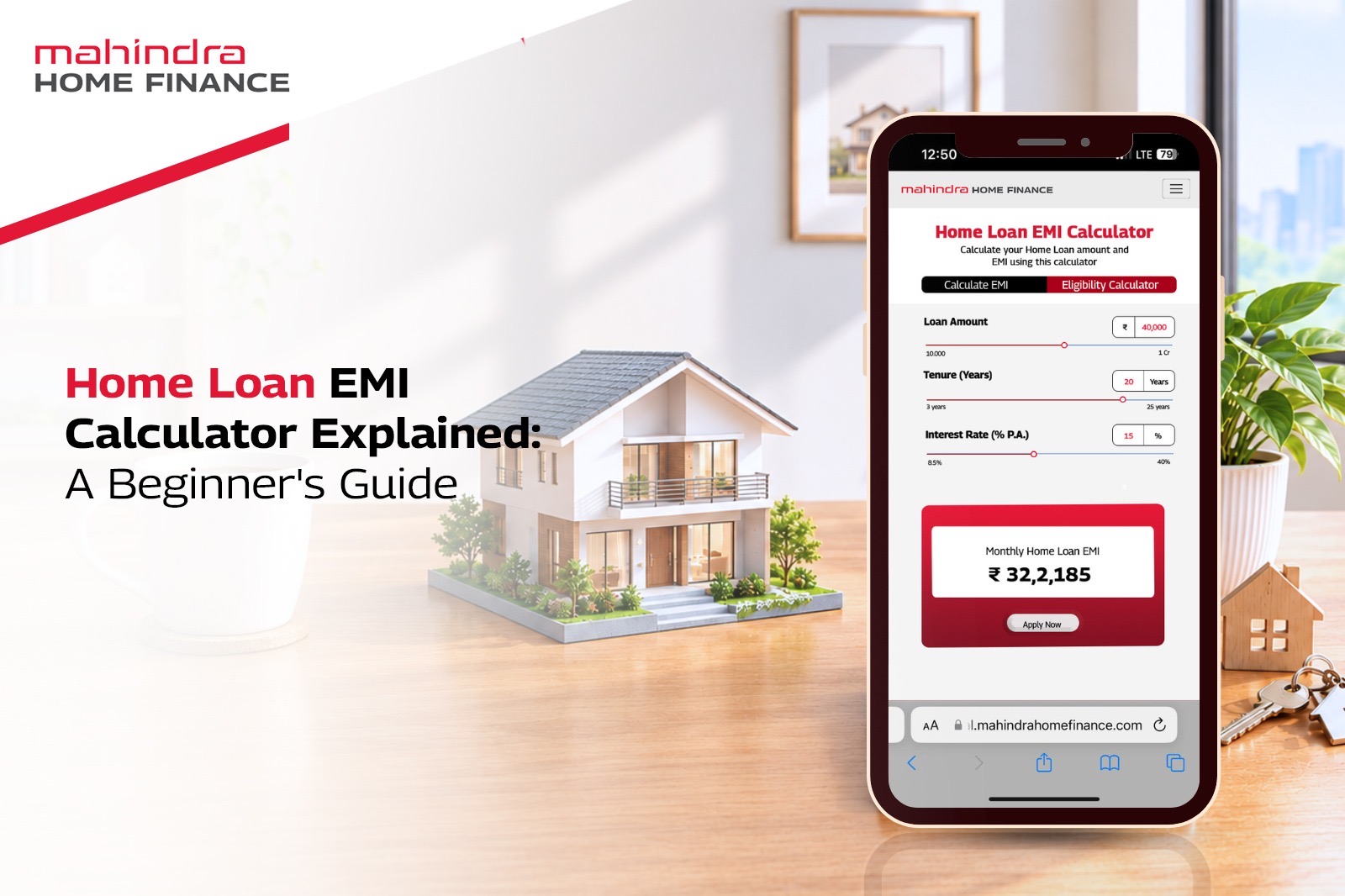
Mahindra Home Finance also provides an online EMI calculator where users can enter the loan amount,
tenure and interest rate to estimate their monthly EMI, total interest and total amount payable.
Calculate Your Home Loan EMI
If you already have an approximate loan requirement, calculating your EMI is a good starting point.
Calculate with the Mahindra Home Finance EMI Calculator
Monthly Home Loan EMI
*Subject to change post credit evaluation
Use the Mahindra Home Finance EMI Calculator to enter your loan amount, preferred tenure and
applicable interest rate.
The calculator also provides an estimate of the total interest and total amount payable, helping you look
beyond the monthly EMI.
How Does a Home Loan EMI Calculator Work?
The EMI you pay is influenced by the amount borrowed, the interest rate and the repayment period.
Loan amount
The higher the amount you borrow, the higher your EMI is likely to be, assuming the interest rate and
tenure remain unchanged.
For example, borrowing ₹40 lakh will generally result in a lower EMI than borrowing ₹50 lakh at the
same interest rate and tenure.
Interest rate
The interest rate directly affects the cost of borrowing.
A higher interest rate generally means a higher EMI and a higher total interest outgo, while a lower rate
can reduce the cost of the loan.
For floating-rate loans, the applicable rate can change during the loan tenure. RBI's framework requires
lenders covered by its reset framework to communicate options available to borrowers when interest
rates reset, including changes to EMI/tenure and, subject to applicable conditions, prepayment options.
Loan tenure
Tenure is the length of time you take to repay the loan.
A longer tenure generally reduces the monthly EMI but increases the total interest payable over the life
of the loan. A shorter tenure usually means a higher EMI but can reduce the overall interest cost.
This is why looking only at the EMI can be misleading. The total repayment amount matters too.
How Is Home Loan EMI Calculated?
The standard EMI formula is:
EMI = P × r × (1 + r)ⁿ / [(1 + r)ⁿ – 1]
Where:
• P = Principal loan amount
• r = Monthly interest rate
• n = Total number of monthly instalments
For example, if you borrow ₹50 lakh at an illustrative interest rate of 8.5% p.a. for 20 years, the
estimated EMI is approximately ₹43,391 per month.
The same loan can produce a very different EMI if you change the tenure or interest rate. This is why an
EMI calculator is useful when comparing different repayment options.
What Does Your EMI Calculation Really Tell You?
Your EMI is only one part of the calculation. A good EMI estimate should help you understand four numbers.
1. Monthly EMI
This is the amount you are expected to pay towards the loan each month, based on the assumptions
entered into the calculator.
2. Total interest
This is the estimated interest you would pay over the selected tenure if the rate and repayment
assumptions remain unchanged.
3. Total repayment
This combines the principal borrowed and the estimated interest payable.
4. Loan tenure
Your tenure determines how long you will remain committed to the repayment schedule.
For example: A longer tenure can make the monthly EMI easier to manage, but you may pay
considerably more interest over time.
So when comparing two loan options, don't ask only:
"Which one has the lower EMI?"
Also ask:
"How much will I pay in total?"
What Happens If You Change Your Loan?
One of the biggest advantages of an EMI calculator is that you can experiment with different scenarios.
What if you increase the loan amount?
Your EMI and total interest generally increase.
What if you choose a lower loan amount?
Your monthly repayment and overall interest burden can reduce.
What if the interest rate changes?
A change in the interest rate can affect your EMI, total interest or repayment period, depending on how
the loan is structured.
What if you increase the tenure?
Your monthly EMI may reduce, but the total interest paid over the longer repayment period can
increase.
What if you increase your down payment?
A larger down payment can reduce the amount you need to borrow. A smaller principal generally means
a lower EMI and lower interest cost, all else being equal.
This makes the EMI calculator particularly useful for scenario planning rather than simply checking one
EMI figure.
How Much Home Loan EMI Can You Comfortably Afford?
The maximum EMI you can technically qualify for and the EMI you can comfortably afford are not
necessarily the same.
Before deciding on a loan amount, look at your complete monthly cash flow.
Consider:
• Monthly income
• Existing EMIs
• Household expenses
• Insurance premiums
• Education or family-related expenses
• Regular savings and investments
• Emergency fund requirements
• Expected future expenses
For example, choosing a higher loan amount because the EMI appears manageable today may become
difficult if your expenses increase later.
A practical approach is to calculate your expected EMI, account for your existing financial commitments
and leave enough room in your monthly budget for unexpected expenses.
The goal should not be to borrow the maximum possible amount. It should be to choose a repayment
amount you can manage comfortably over the long term.
₹50 Lakh Home Loan: Compare 15, 20, 25 & 30 Years
Tenure can make a significant difference to your monthly EMI and total interest.
Consider a ₹50 lakh home loan at an illustrative interest rate of 8.5% p.a.
| Tenure | Approx. Monthly EMI | Approx. Total Interest | Approx. Total Repayment |
|---|---|---|---|
| 15 years | ₹49,237 | ₹38.63 lakh | ₹88.63 lakh |
| 20 years | ₹43,391 | ₹54.14 lakh | ₹1.04 crore |
| 25 years | ₹40,261 | ₹70.78 lakh | ₹1.21 crore |
| 30 years | ₹38,446 | ₹88.40 lakh | ₹1.38 crore |
Illustration calculated at 8.5% p.a. Actual figures will vary depending on the applicable interest rate, loan terms and repayment structure.
What does this comparison show?
The difference in monthly EMI between 15 years and 30 years is around ₹10,800.
That may make the longer tenure look attractive.
However, the estimated total interest rises substantially—from about ₹38.63 lakh to ₹88.40 lakh in this
illustration.
This is the key trade-off:
• Shorter tenure → higher EMI, lower overall interest
• Longer tenure → lower EMI, higher overall interest
The right choice depends on your income, expenses, financial goals and repayment capacity.
Can Prepayments Reduce Your Home Loan Interest?
Making an eligible part-prepayment can reduce the outstanding principal on your home loan. When the
principal reduces, the interest charged on the remaining loan can also reduce.
For example, suppose you receive a bonus or have surplus savings and decide to make a permitted part-
prepayment. Depending on the lender's terms, this may help reduce the outstanding loan and
potentially shorten the repayment period or reduce the EMI.
However, prepayment rules and applicable charges depend on the type of loan, lender and applicable
terms. Borrowers should check their loan agreement and the lender's current schedule of charges
before making a decision.
For example, Mahindra Home Finance publishes its current applicable charges separately, including
conditions for part-payment/prepayment that vary by loan type and circumstances.
For floating-rate individual loans, RBI has also issued rules concerning prepayment/foreclosure charges
for applicable regulated lenders, so borrowers should check which rule applies to their specific loan.
The important point: Don't assume that every home loan has the same prepayment rules.
Home Loan EMI Calculator vs Home Loan Eligibility Calculator
These two calculators answer different questions.
| EMI Calculator | Eligibility Calculator |
|---|---|
| Estimates your monthly EMI | Estimates how much you may be eligible to borrow |
| Uses loan amount, rate and tenure | Considers factors such as income and existing obligations |
| Helps plan repayment | Helps understand potential borrowing capacity |
| Useful before choosing loan amount | Useful before deciding how much to apply for |
In simple terms:
EMI Calculator: "If I borrow this amount, what could my monthly repayment look like?"
Eligibility Calculator: "Based on my financial profile, how much home loan might I qualify for?"
Mahindra Home Finance provides both EMI and eligibility tools, allowing borrowers to use them at
different stages of home-loan planning.
EMI Calculator vs Your Actual Home Loan EMI
An EMI calculator gives you an estimate, not a loan sanction.
The final EMI can differ because the actual loan may involve:
• Final sanctioned loan amount
• Applicable interest rate
• Actual disbursement
• Loan tenure
• Repayment structure
• Changes in floating interest rates, where applicable
• Other applicable loan terms
For this reason, use the calculator to plan and compare, but refer to the final sanction and loan
documents for the actual repayment obligations.
Common Mistakes to Avoid When Using an EMI Calculator
1. Looking only at the EMI
A lower EMI does not automatically mean a cheaper loan. Check the total interest and total repayment
as well.
2. Choosing the longest tenure automatically
A longer tenure can make the monthly payment easier, but it can substantially increase the overall
interest cost.
3. Using an unrealistic interest rate
Don't select an interest rate simply because it produces a lower EMI. Use the rate applicable to your
loan/product or a realistic rate for estimation.
4. Borrowing more because the calculator allows it
Your borrowing capacity is not necessarily the same as your comfortable repayment capacity.
5. Forgetting existing financial commitments
Existing EMIs and regular expenses can affect how much of your income is actually available for a new
home loan.
6. Treating the calculator result as a final offer
The result is an estimate. The actual loan terms are determined after the lender evaluates the
application.
Before You Apply: Home Loan EMI Checklist
Before finalising your home loan, ask yourself:
• What loan amount do I actually need?
• How much can I contribute as a down payment?
• What EMI can I comfortably manage every month?
• How much interest will I pay over the selected tenure?
• Would a shorter tenure be affordable?
• Do I already have other EMIs?
• Do I have enough savings for emergencies?
• Have I checked the applicable interest rate and loan terms?
• Have I understood the applicable fees and charges?
• Have I compared different repayment scenarios?
Running these numbers before applying can help you approach the home-buying decision with a clearer
idea of your financial commitment.
Plan Your Home Loan With Mahindra Home Finance
Choosing a home loan is not only about finding a loan amount. It is also about finding a repayment
structure that fits your financial situation.
Mahindra Home Finance offers home loan solutions across different housing needs, including home
purchase, construction, home improvement and other housing-related requirements. Its website also
provides online tools to help customers plan their borrowing and repayment.
Home Loan
Home Loan Eligibility Calculator
Home Loan EMI Calculator
Calculate Your Home Loan EMI With Mahindra Home Finance
Know your estimated EMI before you plan your home loan.
Use the Mahindra Home Finance EMI Calculator to enter your:
Loan Amount | Interest Rate | Loan Tenure
and get an estimate of your:
Monthly EMI | Total Interest | Total Amount Payable
Calculate your EMI with Mahindra Home Finance
Monthly Home Loan EMI
*Subject to change post credit evaluation
The calculator provides an indicative estimate. Actual loan terms, interest rate, EMI and repayment obligations are subject to applicable eligibility criteria, loan terms and conditions.
FREQUENTLY ASKED QUESTIONS (FAQs)
A home loan EMI calculator is an online tool that estimates the monthly instalment for a home loan based on the loan amount, interest rate and repayment tenure.
Home loan EMI is calculated using the principal amount, monthly interest rate and total number of monthly instalments. The standard EMI formula is used to calculate the estimated monthly repayment.
The main factors are the loan amount, interest rate and loan tenure. Changes in any of these can affect the EMI and total repayment.
Not necessarily. A longer tenure can reduce the monthly EMI, but it generally increases the total interest paid over the loan period. A shorter tenure can increase the EMI while reducing the overall interest cost.
You can consider borrowing a lower amount, making a larger down payment, choosing a suitable interest rate or selecting a longer tenure, depending on your financial situation. However, a longer tenure may increase total interest.
No. It provides an estimate based on the information entered. Your actual EMI will depend on the final sanctioned loan amount, applicable interest rate, tenure, disbursement and loan terms.
Yes. One of the biggest advantages of an EMI calculator is that you can change the loan amount and compare different repayment scenarios.
Yes. For loans where the interest rate can reset, a change in the applicable rate can affect the repayment structure. Depending on the lender's applicable framework and borrower options, this may affect the EMI, tenure or both.
A permitted part-prepayment reduces the outstanding principal. This can reduce the interest payable over the remaining period, subject to the loan's terms and how the lender applies the prepayment.
There is no single answer for every borrower. A lower EMI may provide greater monthly flexibility, while a shorter tenure can help reduce the overall interest cost. The better option depends on your income, expenses and long-term financial plans.
Final Takeaway
A home loan EMI calculator is more than a tool for finding one monthly number. It can help you
understand the relationship between loan amount, interest rate, tenure, EMI and total repayment
before you commit to a long-term financial obligation.
The best approach is to test different combinations instead of immediately choosing the lowest EMI.
Compare the monthly repayment with the total interest, consider your existing commitments and select
a loan structure that remains comfortable for your budget.
Ready to see what your home loan could look like?
Calculate Your Home Loan EMI with Mahindra Home Finance